
Telangana’s Ambitious 41.5-km Ratan Tata Road
Introduction
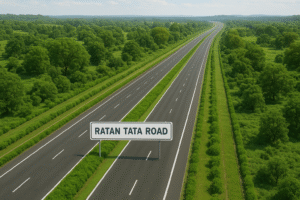
Intro In a bid to improve infrastructure, the government of Telangana recently announced the construction of the Ratan Tata Road, a 41.5-kilometer greenfield expressway, for a cost of ₹ 4,030 crores. This project is likely to positive impact southern urban Hyderabad. This project is likely to improve southern Hyderabad’s Economic Growth , provide positive economic stimulation to southern Hyderabad.

- The road will connect the Tata Interchange at Raviryal on the Outer Ring Road (ORR) to the Regional Ring Road (RRR) at Amangal.
- The road passes through six Rangareddy district mandals: Amangal, Kadthal, Yacharam, Kandukur,Adibatla,Ibrahimpatnam and Maheshwaram.
- The alignment cuts across 14 rural and semi-urban areas, 14 villages, making it a significant project for rural and semi-urban areas.
The Project The Project Has Two Phases:
Phase Stretch Estimated Cost
Phase I Raviryal (ORR) → Meerkhanpet (19.2 km) ₹ 1,665 crore.
Phase II Meerkhanpet → Amangal (22.3 km) ₹ 2,365 crore.
The Hyderabad Metropolitan Development Authority (HMDA) and Hyderabad Growth Corridor Ltd (HGCL) Will Supervise the Construction.
Design & Features
The Ratan Tata Highway Is Not Just Any Highway. It Has Been Designed With Future Growth, Expansion, and Multimodal Transport Integration in Mind :
1.Width & Lanes
- 100-meter-wide access-controlled expressway
- Initially 6 lanes (3+3) and a provision to expand to 8 lanes (4+4) in the future.
2.Tracker Median Reserved For Metro/Rail
- 20-meter central median to be reserved for a future metro or railway corridor, in alignment with the long-term mobility planning.
3.Sustainable & Inclusive Infrastructure
- Service roads on both sides.
- Green belts (2 m wide) for ecological balance.
- Cycle tracks (3 m) and footpaths (2 m) to support non-motorized transport.
- Utility corridors (2 m) for future infrastructure (water, power, telecom).
Strategic Importance & Impact
-
Connectivity Boost
By linking ORR and RRR, the road will ease traffic pressure, especially for commuters and logistics operations traveling through southern Rangareddy and adjoining areas. -
Economic Growth & Development
-
The expressway is expected to unlock development in Future City and adjacent zones, attracting industries, real estate investments, and creating employment.
-
Better infrastructure often leads to higher land values and encourages planned growth in underdeveloped regions.
-
-
Sustainable Mobility
The inclusion of cycle tracks, pedestrian paths, and a reserved corridor for future public transport positions this road as part of Telangana’s more sustainable, multi-modal transport future. -
Long-Term Vision
The design’s flexibility (6 lanes now, expandable to 8) shows foresight, ensuring the expressway can scale as demand grows
Challenges & Considerations
-
Land Acquisition:
Acquiring land for a 100-meter wide corridor across 14 villages may face social, environmental, and legal hurdles. -
Environmental Impact:
When building such a massive expressway, the impact on local ecosystems, especially with forest patches or sensitive areas, must be carefully assessed. Some reports mention reserve forest clearance in parts. -
Funding & Timelines:
Delivering a ₹4,030 crore project efficiently requires tight financial management, transparent tendering, and robust project execution. -
Maintenance & Expansion:
Once built, maintaining a 100-meter wide highway and eventually expanding lanes, integrating a metro/rail corridor, etc., will require sustained investment and political will.
Content ideas:
-
A deep dive into how this expressway will drive real estate investment.
-
Interview-style blog: “What local villagers ,entrepreneurs say about Ratan Tata Road.”
-
Infographic explaining the route, phases, and benefits.
-
Opinion , analysis: “Is naming it after Ratan Tata symbolic of Telangana’s growth ambitions?”